How to See the Aurora (a.k.a. Northern Lights) This Week Across America
Plasma eruptions from the Sun pain the sky with the northern lights, everything to know and how to see them.

We usually think of the weather as whatever is happening outside your window, but space weather is subtler. You wouldn’t know it from looking, but the Earth is currently being blasted by multiple massive coronal mass ejections (CMEs). According to the National Oceanic and Atmospheric Administration (NOAA), the heart of two CMEs are passing over the Earth right now and will continue throughout the night.
Electromagnetic energy from space weather is about eight times stronger than ordinary background rates and it could get stronger. A third and final CME is still on its way, expected to arrive mid-day Wednesday, Nov. 12 (EST). The combined efforts of the CMEs are creating a major disturbance in Earth’s magnetic field, with the potential to cause voltage problems in electrical equipment, mess with GPS systems, and negatively impact satellites in orbit.
That’s the bad news. The good news is a G4 (Severe) geomagnetic storm is expected to push the aurora borealis (northern lights) toward the equator, making a cosmic light show visible from much of the northern United States.
What are coronal mass ejections (CMEs)?
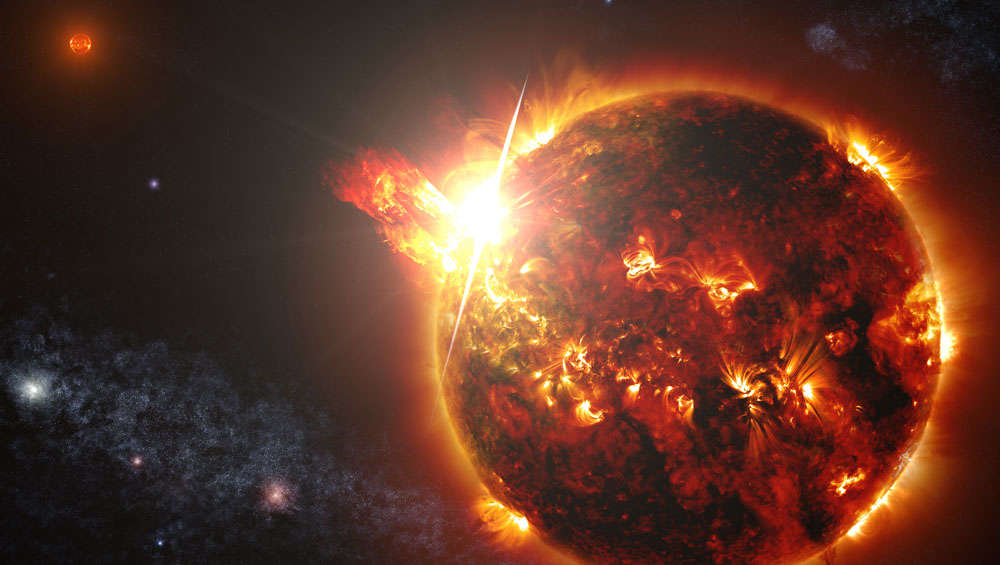
CMEs are massive chunks of charged plasma with embedded magnetic fields, expelled from the surface of the Sun. When flux ropes, highly twisted magnetic field structures on the Sun, get too stressed, they can realign in a more relaxed configuration, a process known as magnetic reconnection. When they reconnect, they sometimes fall back to the Sun’s surface and get reabsorbed, other times they get flung out into space.
Once unleashed, they travel away from the Sun at speeds between 150 and 1,800 miles per second. It can take hours or days for them to cross the 93 million miles of space to reach us, and that’s only if they’re pointed in our direction. Whether or not a CME has an influence on our planet depends on its direction of travel, its strength, and orientation of the magnetic field.
How CMEs cause geomagnetic storms on Earth

The Sun is currently at the maximum phase of its 11-year cycle, so sunspots, solar flares, CMEs, and solar weather events are more common than usual. Most of the time, space weather comes and goes without us really noticing, but there’s potential for serious consequences. Space weather doesn’t impact people on the ground the same way rain and snow does, but because of its electromagnetic nature it can have an outsized impact on our technology.
In 1859, the world was hit by the strongest known geomagnetic storm in history. What became known as the Carrington Event triggered auroras which could be seen as far south as Florida and the Bahamas. In fact, there was so much electricity in the atmosphere that electrical wires got overcharged, shocking telegraph operators and starting small fires. People could send missives over the air, even with their machines unplugged and gibberish messages came in from nowhere.
In 1972, a series of large solar flares and CMEs caused radio blackouts and the explosion of several magnetic sea mines. And in 2003, astronauts aboard the International Space Station (ISS) had to take precautionary shelter from a powerful geomagnetic storm. While the astronauts were fine, it’s possible that NASA’s Advanced Earth Observing Satellite 2 (ADEOS II) may have been lost as a result.
Powerful geomagnetic storms have the ability to wreak serious havoc on our electrical and communications infrastructure. If something like the Carrington Event happened today, it could shut down power grids and take years to recover from. Fortunately, most geomagnetic storms pass without incident and bring beautiful auroras with them.
How space weather turns up the intensity of the northern (and southern) lights
The aurora borealis (northern lights) and aurora australis (southern lights) are caused by high energy electrons smashing into the atmosphere. When coronal mass ejections strike Earth, they deliver more electrons and more energy, making the auroras more impressive.
When accelerated electrons hit the planet, they flow along magnetic field lines toward the poles, where they run into oxygen and nitrogen in the upper atmosphere. Charged electrons then transfer their energy to atoms in the air, raising them to a higher energy state. As they relax to their ordinary state, they release light. It’s a similar process to what’s going on inside a neon light bulb and the colors depend on which atom is involved and what energy state they are raised to.
Because electrons follow magnetic field lines toward the poles, the aurora are usually constrained to small ovals of light, centered around the north and south poles. During extreme weather events, those ovals can swell, pushing the aurora toward the equator.
How to see the northern lights
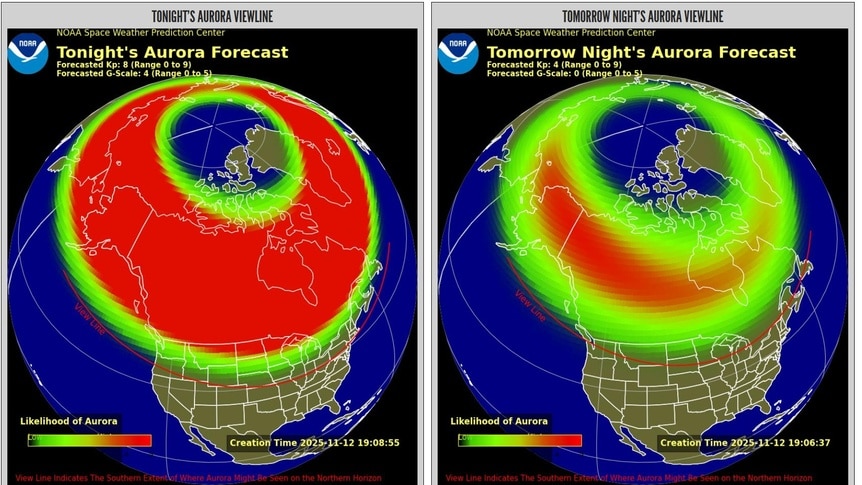
As of early Wednesday, Nov. 12, geomagnetic storm activity had decreased from G4 (Severe) to G3 (Strong), but the nature of the disturbance is such that space weather predictors are expecting G4 conditions or higher as the storm progresses.
The aurora forecast for the evening of Nov. 12 has the view line dipping down over much of the northern United States. Aurora could be visible this evening from Washington, Oregon, Idaho, Montana, Wyoming, North and South Dakota, Nebraska, Minnesota, Iowa, Wisconsin, Illinois, Michigan, New York, Vermont, New Hampshire, and Maine.
If you’re within the view line and want to see the northern lights for yourself, go to a dark skies location, as far from light pollution as possible. If possible, you’ll also want to avoid clouds. While the aurora are an atmospheric phenomenon, they happen higher than the cloud line.
The best views will occur in the couple of hours before and after midnight. Using a camera will also up your odds, because they are better than the human eye at picking up on faint light. And if you don’t get a chance to see the aurora tonight, never fear, there will be other opportunities as solar maximum continues.
Keep your eyes to the skies with the Men in Black trilogy, streaming now on SYFY.