Saturn's Moon Enceladus Makes the Building Blocks of Life and Sprays Them Into Space
Looking inside the complex chemistry of a hidden alien ocean.

When we imagine finding alien life elsewhere in the solar system, we usually think of little green people (or more likely microbes) living on the surface of a rocky Earth-like world. Most of our fiction focuses on Mars or Venus but there’s a growing sense that life could be found in places like Saturn’s icy ocean moon Enceladus.
Recently, astronomers confirmed the presence of organic molecules inside ice grains erupting from the moon’s subsurface ocean. The findings come from data gathered by the Cassini spacecraft, an orbiting scientific laboratory which spent nearly 20 years studying the Saturn system up close.
About the Cassini spacecraft, the Saturn-studying space probe

Cassini launched Oct. 15, 1997 on a long-term mission to Saturn and its moons. After a trio of gravity assists, two from Venus and one from Earth, Cassini went racing toward the outer solar system. It reached Saturn in 2004, nearly 7 years after launch.
In the first few years of its primary mission, Cassini discovered new moons around Saturn, studied the ringed planet, and delivered the Huygens probe to the surface of Titan. In July 2005, Cassini made its first close pass with Enceladus, capturing the moon in stunning detail.
Those images revealed a young surface, almost totally free of impact craters, suggesting the moon is continuously resurfaced by water from the liquid ocean below. Cassini also detected water vapor, fractures in the crust, and icy spray extending into space. Cassini’s primary mission ended in 2008, but the extended mission continued until 2017, when the spacecraft made a few passes through Saturn’s rings and finally plunged into the violent cloudscape of Saturn itself.
Organic molecules and complex chemistry on Saturn’s moon Enceladus
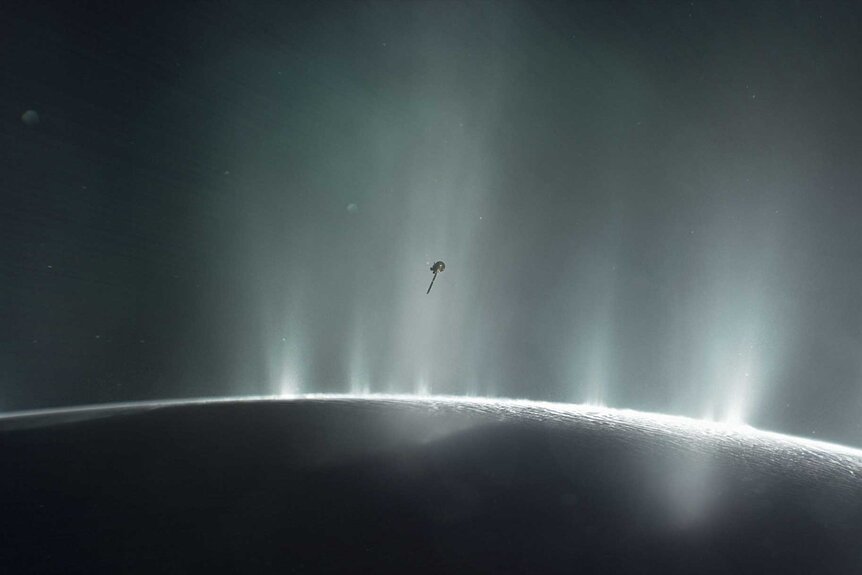
In 2005, Cassini found the first evidence of a liquid water ocean beneath the icy surface of Enceladus. While Saturn and its moons are too far from the Sun to sustain liquid water on the surface, tidal heating from Saturn’s gravity warms the moon’s interior, forming an ocean beneath a thick layer of ice.
Cassini also uncovered jets of chemically rich water erupting through cracks in the moon’s icy surface. Those jets spray out into space and create Saturn’s E ring, which traces the orbit of Enceladus. Inside that spray, astronomers found organic molecules including amino acids.
Studying Saturn’s E ring can provide clues to what’s going on inside Enceladus’ ocean, but many of those frozen grains were ejected hundreds of years ago or more and they have been changed by exposure to space. Looking through the data collected by Cassini, researchers found clear evidence of complex chemistry occurring inside the alien ocean. The findings were published in the journal Nature Astronomy.
The data comes from 2008, when Cassini flew through the spray coming off Enceladus. Importantly, those ice grains were only a few minutes old, giving scientists a fresh window into the moon’s interior. Ice grains smashed into the spacecraft’s Cosmic Dust Analyzer (CDA) traveling approximately 18 kilometers per second (40,000 miles per hour), fast enough to break apart and reveal the signature of organic molecules inside.
“These molecules we found in the freshly ejected material prove that the complex organic molecules Cassini detected in Saturn’s E ring are not just a product of long exposure to space," explained study co-author Frank Postberg, "but are readily available in Enceladus’ ocean.”
In addition to confirming the origin of previously detected organic molecules, researchers detected additional molecules not seen before, including aliphatic, (hetero)cyclic ester/alkenes, ethers/ethyl and, tentatively, nitrogen- and oxygen-bearing compounds. On Earth, those molecules are involved in chains of chemical reactions necessary for life.
We haven’t yet found direct evidence for life on Enceladus, but it’s increasingly clear that Enceladus and other moons like it, with their liquid water and organic molecules, are intriguing places to go looking.
In the meantime, get your alien fix with SYFY’s Resident Alien.