The Martian Treasure Map That Could Lead to Ancient Aliens
Where rivers flow, life follows.

Today, Mars is known as the red planet, for its rust-colored desert landscape. Once upon a time, Mars was a very different place. It had complex waterways and, possibly, ancient aliens. Researchers recently mapped 16 river drainage basins which are key targets in the search for Martians.
We’ve been studying Mars for a long time. The earliest Mars missions launched in the ‘60s and were predominantly flyby missions. Over the next couple of decades, humanity put spacecraft in orbit around Mars and even landed on the surface.
Early rovers like Pathfinder, Sojourner, and the twin Mars Exploration Rovers, Spirit and Opportunity, laid the groundwork for today’s rolling laboratories. At the time of writing, Mars is under observation by the Odyssey orbiter, Mars Express orbiter, Mars Reconnaissance Orbiter, MAVEN (possibly lost), the Curiosity and Perseverance rovers, and other spacecraft.
Despite more than 50 years of intense study and exploration, there’s still a lot of basic information we don’t know about Mars, like where all the major waterways were. In a new study published in PNAS, researchers from the University of Texas at Austin took data from Odyssey to figure out where ancient Martian rivers ran.
“We did the simplest thing that could be done,” said lead author Abdallah S. Zaki, in a Dec. 1 statement. “We just mapped them and pieced them together.”

This new Martian river map could lead to signs of ancient alien life
On Earth, large river basins are home to some of the richest ecosystems in the world. The Amazon River basin, which surrounds the world’s largest river, is a biodiversity hotspot with tens of thousands of species and counting.
Generally speaking, the larger the river system is, the more nutrients get transported through erosion, and those nutrients fuel diverse ecosystems. In fact, previous research suggests that the erosion of mountain ranges has fed biological bursts more than once throughout Earth’s history. Scientists hypothesize that similar environments on Mars would have made the most promising locales for the emergence of Martian life.
“We’ve known for a long time that there were rivers on Mars,” said co-author Timothy A. Goudge. “But we really didn’t know the extent to which the rivers were organized in large drainage systems at the global scale.”
On Earth, large, continental-scale drainage systems cover roughly half of the land, reshaping the planet’s surface and influencing ecosystems. Our planet has 91 large river basins spanning more than 100,000 square kilometers, thanks in large part to tectonic activity. As tectonic plates move around, they create mountains which provide diverse topography to channel rivers. Mars, by contrast, lacks tectonic activity, resulting in a more homogeneous typography and fewer river basins.
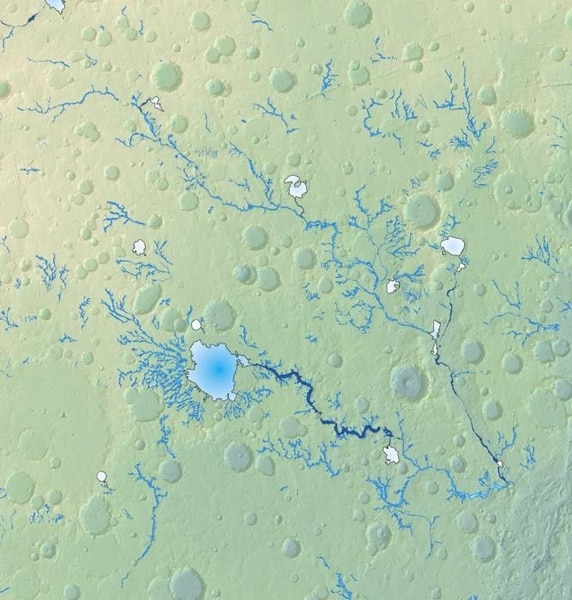
Researchers identified 19 clusters of valley networks, streams, lakes, canyons, and sediment deposits on Mars. Sixteen of those were interconnected into watersheds 100,000 square kilometers or larger. Large drainage systems make up only five percent of the Martian landscape, but account for roughly half of all eroded sediment.
“The longer the distance, the more you have water interacting with rocks.” Zaki explained. “So there’s a higher chance of chemical reactions that could be translated into signs of life.”
Researchers suspect the Martian drainage structure probably created a mosaic of habitable environments across the surface. These findings could inform future missions to Mars by highlighting where signs of ancient life are most likely to be hiding.
Get your extraterrestrial fix with Resident Alien, streaming now on SYFY.