How to See the Quadrantid Meteor Shower From the U.S.
The 2026 Quadrantid meteor shower coincides with a January supermoon.

Every winter in late December, kids (and adults) everywhere look up for a special delivery of gifts from the sky. We’re talking, of course, about the Quadrantids meteor shower.
The Quadrantids run from Dec. 28, 2025 through Jan. 12, 2026, with a peak on the evening of Jan. 3 - 4. This winter meteor shower is one of the strongest of the year, with a short peak of only about six hours. By comparison, most meteor showers peak for about two days. The Quadrantids peak is brief but powerful, due to a thinner stream of meteoroid particles and the angle at which Earth hits the stream.
Under ideal dark skies conditions, you can see between 60 and 200 meteors per hour. On any given year, you’re more likely to see about 25 meteors per hour, and this year’s bright full moon will complicate things.
Where the Quadrantid meteor shower comes from
The Quadrantids were first observed in 1825 and their origin is unusual. Most meteors showers are created by debris from comets, but the Quadrantids originate from the asteroid 2003 EH1. It’s possible that 2003 EH1 could be a dead comet, also known as a rock comet. If that’s the case, it was once more comet-like, but has since expelled most of its ice, so it looks and behaves more like an asteroid today.
The asteroid orbits the Sun every 5.5 years and, as it gets close to the Sun, bits of the asteroid break away, creating a debris trail along its path. Every year, Earth flies through that trail, smashing into bits of rock and dust like so many cosmic bugs on our planetary windshield.
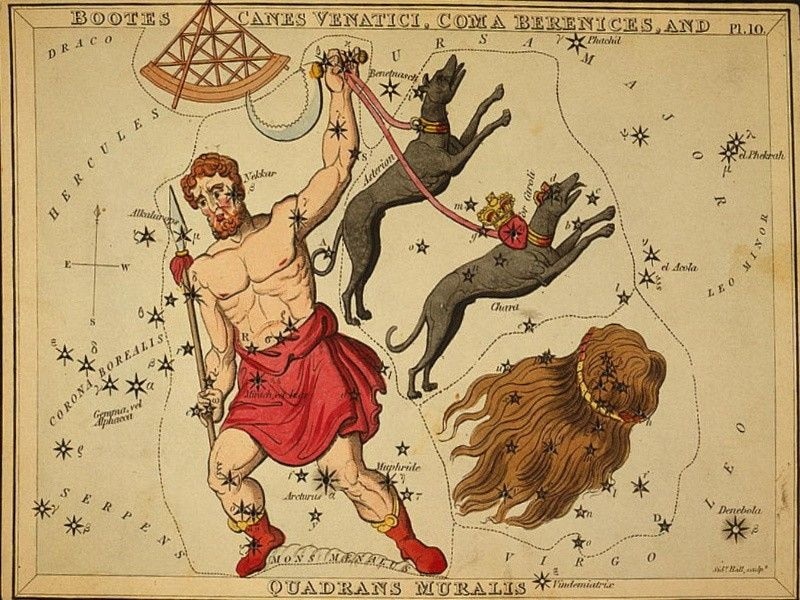
Because meteor showers come from a stream of particles from an asteroid or comet, they appear to radiate from a central point. When astronomers name a meteor shower, they look for the constellation closest to the radiant point. The Quadrantids take their name from an obsolete constellation called Quadrans Muralis. You can find it near the constellation Boötes, adjacent to the handle of the Big Dipper.
How to see the 2026 Quadrantid meteor shower

Quadrantid meteors enter the atmosphere at 25 miles per second (90,000 mph) leaving streaks of light and color across the sky. Their shower is best seen from the northern hemisphere during late night and pre-dawn hours.
It’s winter in the northern hemisphere, so make sure to prepare with warm clothes, blankets, sleeping bags, lawn chairs, and whatever else you’ll need to keep warm overnight. For the best view, get away from the city and other sources of light pollution. Give yourself about half an hour for your eyes to adjust to the dark.
There will be a full Moon on the evening of Jan. 3, which will make meteors harder to see. Not only will the Moon be bright, it will also be up all night. January’s full Moon is also a supermoon, the last of four consecutive supermoons, so it will be slightly larger and brighter than usual. Because of the Moon, the total number of visible meteors will be lower. Fortunately, the Quadrantids also feature bright fireballs, explosions of light and color from larger particles, which linger in the sky.
See the cosmos up close in The Ark, streaming now on SYFY.