ACK! ACK! ACK! Mars Attacks Co-Creator Looks Back on Iconic Trading Cards That Shocked America
Released by Topps in the early 1960s, the Mars Attacks line provoked parental outrage for its provocative imagery regarding a hostile alien invasion of Earth.

ACK! ACK! ACK!
If that staccato exclamation conjures up the image of a large-brained alien pointing a ray gun at humanity, then congratulations—you have had the good fortune of seeing Mars Attacks, the 1996 film from Beetlejuice and Batman director Tim Burton.
However, we're not here to talk about Burton's star-studded movie that bombed at the office and with critics (the alien invasion flick that won out that year was, of course, Independence Day).
No, we want to talk about the Topps trading card series upon which the film was based. Unveiled in 1962, Mars Attacks consisted of 55 collectible cards depicting a Martian invasion of Earth. But this wasn't the hokey, man-in-a-rubber-suit type story made popular by the popular sci-fi B-movies of the 1950s and '60s.
The visuals on the Mars Attacks cards were graphic, violent, and utterly sadistic. Humans and animals alike were murdered with impunity, their flesh roasted off the bone as if their attackers were preparing for some kind of extra-terrestrial cookout. The series was so provocative, in fact, that it sparked parental ourage and even led a Connecticut district attorney to order Topps to stop printing the cards.

Who do we have to thank for such indelible imagery?
That would be the men of the Topps Product Development at the time: Woody Gelman and Len Brown. Gelman hired Brown when the latter was just an 18-year-old kid from Brooklyn. Brown would go on to work for the company for more than 40 years before retiring in 2000 to move to Austin, Texas and start his own radio show. At 84, he is the only living member of the original duo as Gelman sadly passed away in 1978.
A moderate success in the 1960s, Mars Attacks has endured all these years later with some of the OG cards selling for upwards of $3,000 at auction. Further sets of cards and merchandise are still being made from the property, which is well over half a century old.
SYFY WIRE rang up Len Brown in his Texas home back in 2018 (the 80th anniversary of Topps' founding) to talk all about his iconic trading cards—from their inception and legacy to that time he tried to nab a cameo in Burton's movie based on his creation.
Interview with Mars Attacks co-creator Len Brown
To start off, how did the idea for Mars Attacks come about at Topps? What was your responsibility for the brand?
Len Brown: Back in those days, there was a lot of science fiction movies being made. It started [with] Woody Gelman, who ran the new product development, and I worked for him. We talked about maybe doing a horror series of trading cards because horror comics were really big a few years prior, then they all got banned—the EC Stuff all got banned. We thought, "Hey, maybe we can get away with doing a horror series," but management was a little nervous when we told them what we were doing. So instead, we felt like, "Well, science fiction's been big" [like] War of the Worlds. The movie that inspired me a lot when I was growing up was a Universal picture that actually had a creature that was very Mars Attacks-looking, sort of a big brain head. This Island Earth. So, we were trying to figure what a Martian should look like, and I showed them a picture from one of the magazines that were coming out, Famous Monsters of Filmland. I showed it to Woody, he liked it, and we had some sketches made up about doing a possible series of cards on a Martian invasion.
What was the process of coming up with the story with Woody Gelman?
LB: Besides being the nicest man I ever met in my life, Woody was a kind-hearted soul and a great boss. He was also a very creative guy and came up with a lot of ideas. He believed that each card should look like a movie poster. You look at the card and there's some story being told without reading the back of the card. [He wanted] something that would make some impact when you looked at the card. So, we would try to come up with a scene of tension, high drama. We sat around and brainstormed a lot of those ideas. Then we brought in a couple of artists to help, people from the comics field. One was Bob Powell, who had done a lot of work for Topps in the past; he was a pretty respected comic book artist in the '40s and '50s. And then Wally Wood gave [us] a hand also. It was just great fun to work on. I remember looking forward on Sunday night, knowing I'd be going into the Topps office on Monday morning and working on this stuff again.
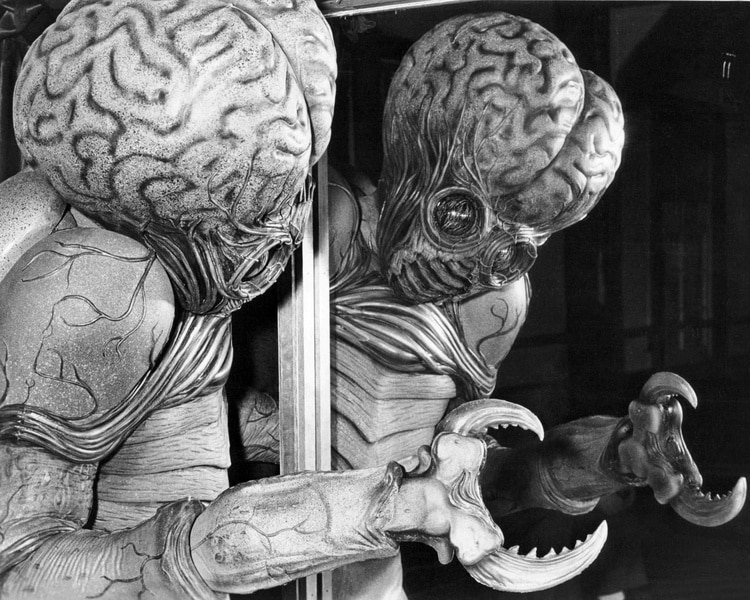
What was the justification for having such graphic content on the cards?
LB: We always felt visuals were important. Why would kids buy trading cards if they didn't wanna collect them and enjoy the visuals? So, we tried to get down to a kid level, and we both felt we knew what kids liked … We had put out enough [sets] that sold well and had a certain amount of freedom in Product Development to pretty much do what we wanted to do. But we did have to get permission from the president of the company, who was very conscious about getting very bad press.
Do have a favorite card or part of the Mars Attacks story that you love the most?
LB: I moved to Austin because of the music. One of the people that I got to know was a pretty popular local artist and when he heard that had I worked for Topps Chewing Gum, he said "Well, I remember a set I collected as a kid. Boy, did I love it!" He's about 10 years younger than I am, but he remembered Mars Attacks. And the one that he brought up is the one so many people bring up: the card where a dog is getting blasted by a ray gun from a Martian. That's a tough thing for a young kid to look at and not pull back in almost abject horror, but they're also fascinated by it at the same time. That always seemed like a very notable one, but there were so many good scenes that we felt we brought to the series. We were looking for shock impact and Woody said they should look like movie posters and catch the attention of anyone mildly interested in the subject matter.
What were your thoughts on the Tim Burton movie based on the game and were you consulted at all for it?
LB: I tried to get involved by writing a note to Tim Burton's office. Topps was very excited to hear a [film was being made about a] property that they created as a little trading card set and was only moderately popular. But I didn't really care for the movie that much. It started out with a scene from one of the cards called “Burning Cattle,” where the cows had been set on fire by Martian ray guns … I remember when it opened, I thought, "Wow! This is gonna be great!" But then to me, it just got to be a comedy. It didn't take itself that seriously and obviously, that's what Tim Burton wanted. I had written him a letter, a note, saying I was the co-creator of Mars Attacks. [I think] I asked him in that letter if I could appear in a scene if I came down, thinking it would be really neat. He never did answer it. I called his office, spoke to his secretary, and she remembered my letter coming in and she said Tim didn't get it.
You mentioned the musician who remembered the burning dog card. Have you had any memorable interactions with fans over the series throughout the years?
LB: Oh, a lot, especially because Topps ultimately got into comic books and we'd go to the comic conventions. We did like 50 issues of [The] X-Files as a comic book and it was pretty successful for a while. When I'd go to comic conventions, the fans being fans knew that Topps had done Mars Attacks and it had its cult following ... They would ask about a lot of their favorite cards. I'd be signing autographs and comic book covers for them.

What is your proudest contribution to Mars Attacks and what do you think the biggest legacy of the card series is?
LB: Well, its longevity. When we were working on it in the early '60s, we never expected that [there'd] still be a Mars Attacks product coming out 40, 50 years later. When we did a trading card set, it either sold or it didn't. If it sold really well, we might do a second series We had a series called Ugly Stickers that was very, very successful and far outsold Mars Attacks.
Have you worked on any sci-fi, fantasy, or horror properties other than Mars Attacks?
LB: Besides creating our own property like Mars Attacks, we would license Star Wars and probably [released] more series of Star Wars than any other property … That was such a phenomenon when it came out in '77. We licensed Alien and did cards for the original movie ... We tended to look for the big blockbuster, science fiction stuff. We felt there was a market for that. There still seems to be.
How do you feel about the original Mars Attacks cards becoming such coveted rarities and selling for upwards of $3,000 at auction in some cases?
LB: I'm proud. I feel that between Woody and myself, it was part of our legacy in a way … We're still putting out reprints of the original series; they're brainstorming new subjects [to keep it going] … I'm happy it's still around in the form it is. Topps seems to realize what they've got and we certainly didn't realize that when we created it.
**EDITOR'S NOTE: A version of this article appeared on SYFY WIRE in April 2018 for Topps' 80th anniversary